Series1-Episode 3 Singapore
"A command center for APAC business expansion, not a mass-sales market"
Singapore is an extremely critical market in APAC as a hub for regional management, verification, and commercialization of high-value-added industries, despite its small population and land size. Rather than focusing on the quantitative expansion of domestic demand, it functions as a command center for expanding advanced manufacturing, specialty chemicals, water technology, and Climate Tech into APAC by combining the attraction of foreign capital, R&D, regulatory development, government support, and financial/human resource foundations.
The government is advancing the sophistication of fields such as semiconductors, specialty chemicals, water treatment, low-carbon energy, and the circular economy through Manufacturing 2030, RIE2030, Green Plan 2030, water policy, carbon tax, hydrogen strategy, and the transition of Jurong Island. In particular, making Jurong Island sustainable, water policy centered on NEWater and desalination, and the phased increase of the carbon tax are significant market-forming factors for materials, chemicals, water treatment, and Climate Tech companies. Therefore, Singapore should be positioned not as a "mass-sales market" but as a strategic base for designing APAC business strategies, verifying technology, and expanding into neighboring countries. From a Business Development perspective, the ability to connect government agencies, research institutes, foreign regional headquarters, Japanese companies, and the ASEAN market becomes crucial.
- Macro Environment
Population, Labor Force, GDP, Industrial Structure, FDI, and R&D Singapore is a city-state with a small land area and population among the major APAC countries. However, in terms of economic scale, income levels, FDI accumulation, research and development investment, and the sophistication of its manufacturing industry, it is not merely a small market but occupies an important position as a hub for high-value-added industries, regional headquarters, and verification in APAC.
Regarding population, according to the Singapore Department of Statistics, the total population of Singapore as of June 2025 is 6.11 million. This indicates that, unlike population-expanding markets such as India, Vietnam, Thailand, and Malaysia, Singapore is not a country that relies solely on the quantitative expansion of its domestic consumer market as a source of growth. (singstat.gov.sg)
In terms of the economy, the Ministry of Trade and Industry announced that the Singapore economy grew by 4.4% in 2024. Furthermore, according to 2025 data from the Singapore Department of Statistics, the GDP is 789.5 billion SGD, and the per capita GDP is 129,194 SGD. This demonstrates that while Singapore is small in terms of population size, it possesses a high-income, high-value-added economic structure. (Ministry of Trade and Industry)
In the industrial structure, as of 2025, manufacturing accounts for 18.5% of GDP. While the service industry is central, the fact that manufacturing still holds a large weight is important. The Singapore Department of Statistics states that in 2025, over 70% of nominal value-added was generated from the service industry and about 25% from goods-producing industries. (singstat.gov.sg)
Regarding FDI, the Singapore Department of Statistics announced that the inward FDI stock in Singapore's corporate sector reached 3.13 trillion SGD by the end of 2024, a 9.5% increase year-on-year. Major investment sources include the US, Japan, UK, and Hong Kong, with the US being the largest FDI supplier. This indicates that Singapore functions as a hub for investment, management, manufacturing, and research and development for global companies, rather than just being one country in the ASEAN market. (singstat.gov.sg)
Regarding research and development, the National Research Foundation states that under RIE2030, 37 billion SGD will be invested in research, innovation, and enterprise activities over the next five years. RIE2030 aims to concentrate R&D efforts on priority areas of high economic or strategic value for Singapore. (nrf.gov.sg)
Assessment of Macro Environment Singapore is not a population-expanding market. Rather, it is a high-density economy that combines high income, foreign capital concentration, R&D investment, manufacturing sophistication, and regional management functions. Therefore, for materials, chemicals, water treatment, and Climate Tech companies, the value of the Singapore market lies not in "mass sales" but in the management, verification, commercialization, trust formation, and regulatory response for APAC expansion.
- Government Strategy
Manufacturing 2030, RIE2030, Green Plan, Hydrogen, and Water Policy One of the most important pillars of the Singapore government's industrial policy is Manufacturing 2030. The Singapore Economic Development Board (EDB) has set a goal for Manufacturing 2030 to increase manufacturing value-added by 50% by 2030 compared to 2020 levels. This is a policy designed to maintain and strengthen Singapore's position as a manufacturing base for advanced manufacturing, semiconductors, pharmaceuticals, specialty chemicals, and high-value-added materials, rather than just being a service and financial hub. (edb.gov.sg)
In research and innovation policy, RIE2030 is central. The National Research Foundation states that under RIE2030, 37 billion SGD will be invested in research, innovation, and enterprise activities, concentrating R&D efforts on priority areas of high economic or strategic value for Singapore. (nrf.gov.sg)
In environmental and decarbonization policy, the Singapore Green Plan 2030 is crucial. The plan aims to reduce waste sent to landfills by 30% by 2030, reduce household water consumption to 130L per person per day by 2030, and ensure that all new car registrations from 2030 are clean energy models. (Singapore Green Plan 2030)
Regarding carbon policy, Singapore was the first country in Southeast Asia to introduce carbon pricing. The Ministry of Sustainability and the Environment states that the carbon tax will be raised from 5 SGD/tCO₂e (2019–2023) to 25 SGD/tCO₂e (2024–2025) and 45 SGD/tCO₂e (2026–2027), aiming for 50–80 SGD/tCO₂e by 2030. (mse.gov.sg)
In the energy transition, hydrogen is a critical policy area. The Ministry of Trade and Industry states that hydrogen, along with solar, imported electricity, and other low-carbon energy sources, will complement and diversify the power mix, potentially supplying up to half of the electricity demand by 2050 depending on technological progress and the development of other energy sources. (Ministry of Trade and Industry)
Water policy is also at the core of the national strategy. According to PUB, Singapore's water demand is currently about 440 million gallons per day and could nearly double by 2065. Furthermore, it is stated that the non-household sector will account for approximately 60% of water demand by 2065, with NEWater and seawater desalination meeting the majority of future water demand. (PUB, Singapore’s National Water Agency)
Assessment of Government Strategy The Singapore government's policies are designed as national strategies for high-value-added manufacturing, R&D, attracting foreign capital, water resource management, decarbonization, and regional management, rather than expanding domestic demand through population growth. For materials, chemicals, water treatment, semiconductor, and Climate Tech companies, the policies themselves act as market-creating factors.
- Industrial Opportunity
Strategic Sectors and Market Opportunities The following are the industrial opportunities that will be important in Singapore for 2030–2035.
|
Sector
|
Importance
|
Rationale Based on References
|
Business Opportunity
|
|
Semiconductors & Advanced Mfg
|
★★★★★
|
Manufacturing 2030 targets a 50% value-add increase by 2030. EDB positions SG as an advanced mfg hub.
|
High-purity materials, cleaning chemicals, CMP, thermal management, encapsulation, equipment parts
|
|
Specialty Chemicals & Functional Materials
|
★★★★★
|
Jurong Island is the core of energy/chemicals; EDB indicates transition to sustainable products, specialty chemicals, and low-carbon tech.
|
Specialty chemicals, sustainable materials, electronic materials, functional polymers
|
|
Water Treatment & Industrial Water
|
★★★★★
|
PUB expects water demand to nearly double by 2065, with NEWater/desalination meeting future demand.
|
Energy-saving membranes, adsorbents, industrial water reuse, ultrapure water, wastewater treatment
|
|
Climate Tech & Carbon Reduction
|
★★★★☆
|
Carbon tax targets 50–80 SGD/tCO₂e by 2030.
|
Energy-saving equipment, emission reduction tech, CCUS, low-carbon materials
|
|
Hydrogen & Low-Carbon Fuels
|
★★★★☆
|
Hydrogen could supply up to half of power demand by 2050.
|
Hydrogen carriers, ammonia, catalysts, separation membranes, safety materials
|
|
Chemical Recycling & Waste Reduction
|
★★★★☆
|
Green Plan 2030 targets 30% reduction in landfill waste.
|
Resin recycling, sorting, depolymerization, quality stabilization of recycled materials
|
|
Bio & Pharma Manufacturing
|
★★★★☆
|
EDB includes pharmaceutical manufacturing in Singapore's manufacturing ecosystem.
|
Purification materials, single-use materials, analysis, process control materials
|
Regarding semiconductors and advanced manufacturing, the policy to grow the manufacturing industry under Manufacturing 2030 is clear. EDB indicates that multinational companies are establishing next-generation manufacturing facilities in Singapore, and that not only manufacturing facilities but also HQ, R&D, and supply chain management functions are located in Singapore. (edb.gov.sg)
Regarding specialty chemicals and functional materials, Jurong Island is critical. EDB aims to operate Jurong Island sustainably and transform it into an energy and chemicals park that manufactures sustainable products for the world. Furthermore, JTC explains that since 2021, there have been over 30 specialty chemical projects by global companies including Arkema, Cariflex, and Kuraray, many of which are located on Jurong Island. (edb.gov.sg)
Regarding water treatment and industrial water, PUB's water demand outlook is important. In Singapore, water demand is expected to nearly double by 2065, with the non-household sector accounting for approximately 60%. This indicates that demand for industrial water, reused water, wastewater treatment, energy-saving membranes, adsorbents, and micro-pollutant removal will increase in industrial applications such as semiconductors, pharmaceuticals, specialty chemicals, and data centers. (PUB, Singapore’s National Water Agency)
- Regulatory Landscape
Chemical Substances, Carbon Tax, Water, and Waste Regulations Regulatory compliance is important for materials and chemical companies entering the Singapore market. Regarding chemical substance management, NEA states that it will mandate chemical substance reporting for hazardous substance license and permit holders starting January 1, 2026. Upon license or permit renewal, companies must screen chemical substances imported into or manufactured within Singapore and report those meeting the reporting criteria to NEA. (nea.gov.sg)
Also, the Environmental Protection and Management Act and the Environmental Protection and Management Regulations are the fundamental systems for hazardous substance management. Singapore Statutes Online indicates that the Environmental Protection and Management Act is the law concerning environmental pollution control, environmental protection, and resource conservation. (sso.agc.gov.sg)
Regarding chemical substance management in the workplace, the Ministry of Manpower classifies carcinogens, corrosives, explosives, and flammables as hazardous substances based on the WSH Act. Furthermore, the Workplace Safety and Health Regulations stipulate that hazardous substances in the workplace must be stored, used, handled, and disposed of in a manner that does not create risks. (Ministry of Manpower Singapore)
Regarding carbon regulation, Singapore's carbon tax is important. The Ministry of Sustainability and the Environment targets raising the carbon tax from 5 SGD/tCO₂e (2019–2023) to 25 SGD/tCO₂e (2024–2025) and 45 SGD/tCO₂e (2026–2027), reaching 50–80 SGD/tCO₂e by 2030. (mse.gov.sg)
Regarding water regulation, the Ministry of Sustainability and the Environment explains that PUB monitors industrial wastewater because wastewater containing prohibited or regulated substances affects water reclamation plants and NEWater production. This means that wastewater management, water quality management, and micro-pollutant management will be important conditions for entry for industries such as chemicals, semiconductors, pharmaceuticals, and metal processing. (mse.gov.sg)
In waste policy, the Singapore Green Plan 2030 sets a goal to reduce landfill waste by 30% by 2030. (Singapore Green Plan 2030)
Assessment of Regulatory Landscape Singapore's regulations are not merely barriers to entry. Chemical substance reporting, the carbon tax, water quality management, and waste reduction are market-forming factors that create demand for low environmental impact materials, energy-saving processes, wastewater treatment, reused water, chemical recycling, and low-carbon manufacturing.
- Technology Assessment
Technical Challenges, Missing Technologies, and Implementation Challenges Singapore's technological challenges are not a lack of basic research but implementation challenges to maintain high-value-added manufacturing within limited land, water, and energy constraints.
|
Sector
|
Technical Challenges
|
Entry Points for Foreign Companies
|
|
Semiconductors & Advanced Mfg
|
High purification, defect reduction, process stabilization, reduced wastewater load
|
High-purity chemicals, cleaning, CMP, thermal management, encapsulation materials
|
|
Water Treatment
|
Increased water demand, rising industrial water ratio, dependence on NEWater/desalination
|
Energy-saving membranes, adsorbents, concentrated wastewater treatment, sensors
|
|
Specialty Chemicals
|
Decarbonization of Jurong Island, transition to sustainable products
|
Sustainable materials, bio-based materials, low-carbon processes
|
|
Carbon Reduction
|
Emission reduction pressure due to rising carbon tax
|
Energy-saving equipment, CCUS, low-carbon fuels, emission measurement
|
|
Hydrogen
|
Import, storage, utilization, safety management
|
Hydrogen carriers, ammonia, catalysts, separation membranes, durable materials
|
|
Chemical Recycling
|
Landfill waste reduction, resource circulation
|
Depolymerization, sorting, recycled material quality stabilization, catalysts
|
From the perspective of PUB's water demand outlook, water treatment is particularly important. The outlook that water demand will nearly double by 2065 and that the non-household sector will account for about 60% indicates the importance of industrial water treatment, water reuse, and wastewater treatment technologies. (PUB, Singapore’s National Water Agency)
Furthermore, the rise in the carbon tax is not merely a cost-increase factor but acts as investment pressure for energy saving, emission reduction, low-carbon fuels, CCUS, and process improvement technologies. (mse.gov.sg) Regarding Jurong Island, EDB indicates a direction to transform the energy and chemicals park into a hub for sustainable products, specialty chemicals, and low-carbon technologies. This implies an industrial transition from conventional petrochemicals to low-carbon, high-value-added, and sustainable materials. (edb.gov.sg)
- Business Development Opportunity
Entry Points and Collaboration Potential for Foreign Companies Singapore offers values such as: an APAC Regional Management Hub where EDB explains multinational companies locate HQ, R&D, and supply chain management functions; a hub for high-value-added manufacturing, semiconductors, and specialty chemicals; a verification and commercialization market for water technology; a low-carbon and Climate Tech market; and a specialty chemicals and low-carbon materials market centered on Jurong Island.
|
Foreign Company Type
|
Opportunities in Singapore
|
Anticipated Points of Contact
|
|
Semiconductor Materials
|
High-purity chemicals, cleaning, CMP, encapsulation, thermal management
|
EDB, semiconductor manufacturers, equipment manufacturers
|
|
Water Treatment
|
NEWater, desalination, industrial water, wastewater treatment
|
PUB, MSE, semiconductor/chemical plants
|
|
Specialty Chemicals
|
Manufacturing and R&D on Jurong Island
|
EDB, JTC, Jurong Island companies
|
|
Climate Tech
|
Carbon tax compliance, energy saving, CCUS, low-carbon fuels
|
MTI, MSE, EMA, energy companies
|
|
Chemical Recycling
|
Waste reduction, recycled materials, depolymerization
|
MSE, NEA, chemical companies
|
|
Functional Materials
|
Electronic materials, bio/pharma, industrial materials
|
EDB, A*STAR, university, manufacturing firms
|
- Koji Teramoto View
Singapore is a "market for APAC expansion design" rather than a "market of volume" in my view. Although the population size is small, the concentration of FDI, R&D, advanced manufacturing, specialty chemicals, water policy, carbon tax, and low-carbon energy policies makes it an extremely critical base for advanced foreign material companies in building their APAC strategies.
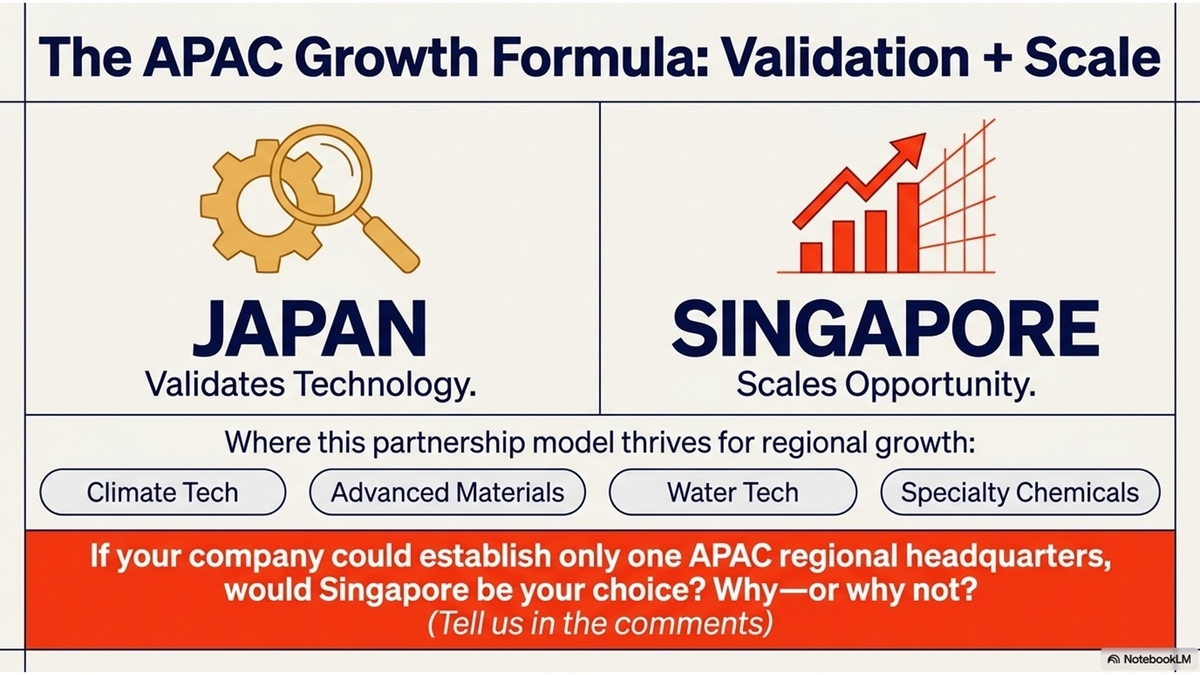
For foreign companies, a workflow of gaining technical reliability in Japan and designing APAC expansion in Singapore is rational.
References
- Singapore Department of Statistics, "Population / Total Population as at Jun 2025." (singstat.gov.sg)
- Ministry of Trade and Industry Singapore, "MTI Maintains 2025 GDP Growth at ‘1.0 to 3.0 Per Cent’." (Ministry of Trade and Industry)
- Singapore Department of Statistics, "National Accounts Latest News & Data." (singstat.gov.sg)
- Singapore Department of Statistics, "Singapore Economy Infographic 2025." (singstat.gov.sg)
- Singapore Department of Statistics, "Foreign Direct Investment in Singapore 2024." (singstat.gov.sg)
- National Research Foundation Singapore, "Research, Innovation and Enterprise 2030." (nrf.gov.sg)
- National Research Foundation Singapore, "RIE2030 Factsheet." (file.go.gov.sg)
- Singapore Economic Development Board, "Singapore’s Advanced Manufacturing Industry." (edb.gov.sg)
- Singapore Green Plan 2030, "Green Plan Key Targets." (Singapore Green Plan 2030)
- Singapore Green Plan 2030, "Our Targets." (Singapore Green Plan 2030)
- Ministry of Sustainability and the Environment Singapore, "Carbon Pricing Act." (mse.gov.sg)
- Ministry of Trade and Industry Singapore, "Hydrogen." (Ministry of Trade and Industry)
- Energy Market Authority Singapore, "Singapore Launches National Hydrogen Strategy." (ema.gov.sg)
- PUB Singapore, "Singapore’s Water Loop." (PUB, Singapore’s National Water Agency)
- Ministry of Sustainability and the Environment Singapore, "Water." (mse.gov.sg)
- National Environment Agency Singapore, "Management of Hazardous Substances." (nea.gov.sg)
- Singapore Statutes Online, "Environmental Protection and Management Act 1999." (sso.agc.gov.sg)
- Singapore Statutes Online, "Environmental Protection and Management (Hazardous Substances) Regulations." (sso.agc.gov.sg)
- Ministry of Manpower Singapore, "WSH Act: Hazardous Substances." (Ministry of Manpower Singapore)
- Singapore Statutes Online, "Workplace Safety and Health Regulations." (sso.agc.gov.sg)
- Singapore Economic Development Board, "Powering Global Innovation in Energy & Chemicals." (edb.gov.sg)
- JTC Corporation, "Jurong Island celebrates 25 years with new focus on specialty chemicals and low-carbon solutions." (jtc.gov.sg)